
What You'll Learn
Six core competency areas — from microcontroller architecture to motor control
Microprocessor & Microcontroller Architecture
Core architecture concepts, embedded system features, applications, and hardware-software co-design.
FoundationArduino & ATmega Programming
Arduino boards, ATmega328 features, memory maps, pin configuration, and register-level programming.
Core SkillSimulation with Proteus & TinkerCAD
Build and test embedded circuits virtually before touching real hardware, using two industry-standard tools.
In-DemandLED Interfacing & Patterns
LED control with switches and serial communication, plus 10+ advanced multi-LED pattern programs.
Applied EngineeringSeven-Segment & LCD Displays
Seven-segment display logic, LCD architecture and registers, 4-bit/8-bit modes, and custom characters.
Production ReadyMotors & Actuator Control
Interface different types of motors and actuators with Arduino/ATmega for real-world embedded projects.
CapstoneBuilt to Get You Hired in Embedded Systems
A program that combines rigorous theory with hands-on hardware practice — so you graduate with both a portfolio and a certificate.
This Embedded Systems course is built on an industry-aligned curriculum. You'll learn microprocessor and microcontroller architecture, embedded system features and applications, and hardware-software co-design principles used in modern embedded product development.
You'll build practical skills with Arduino/ATmega328, Proteus and TinkerCAD simulation, LED and LCD interfacing, seven-segment displays, millis-based timing, and motor/actuator control — so you can design and program real embedded systems projects. The course ends with a performance-based LOR, dual certification, and placement referral support.
Course Benefits
Course Curriculum
Four stages, twelve modules, one pipeline from microcontroller theory to motor control — click any module to expand
- Architecture of microprocessors
- Architecture of microcontrollers
- Key differences & use cases
- Features & applications
- Practical examples & characteristics
- Types of embedded systems
- Challenges in embedded design
- Co-design process & why it matters
- System architecture basics
- Choosing the right Arduino board
- Memory map & pin configuration
- ATmega328 features
- ATmega328 register map
- Arduino C functions vs register commands
- Direct register-level control
- Proteus: know-how
- TinkerCAD introduction
- Setting up your virtual lab
- LED interfacing in Proteus & TinkerCAD
- Controlling an LED with a switch
- LED with serial port
- LED with switch + serial port
- Left/right shift & curtain effects
- Converge, diverge & odd-even patterns
- 10+ patterns with a single port
- Seven segment display theory
- millis() vs delay()
- LCD architecture & registers
- Displaying patterns & effects
- Creating custom characters
- 4-bit vs 8-bit operation
- Types of motors & actuators
- Interfacing with Arduino/ATmega
- Capstone project review
Capstone Hardware Project · Dual Certification · Placement Ready
Every stage feeds into a portfolio-ready embedded engineer — backed by hands-on Arduino projects and a performance-based LOR.
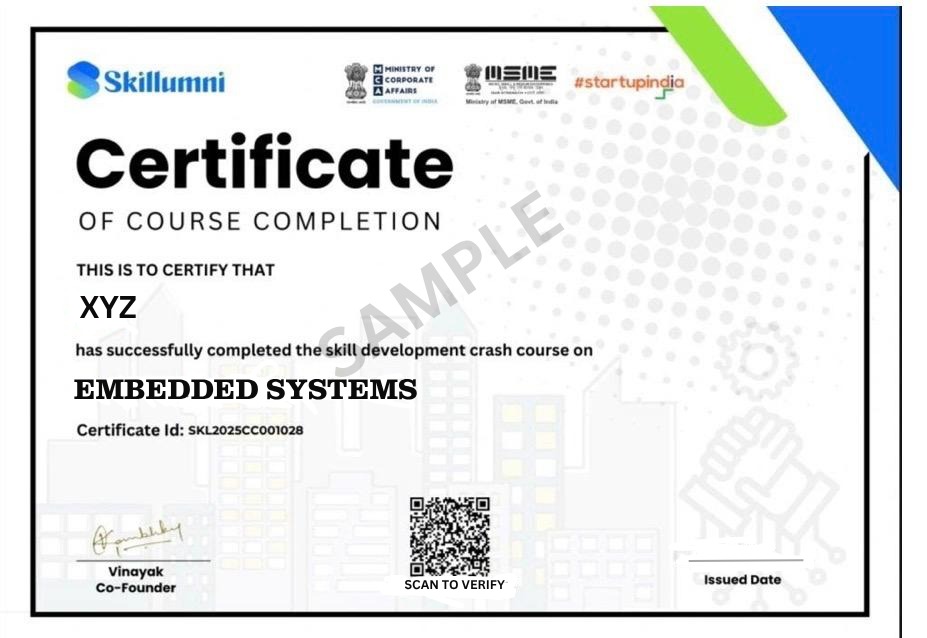
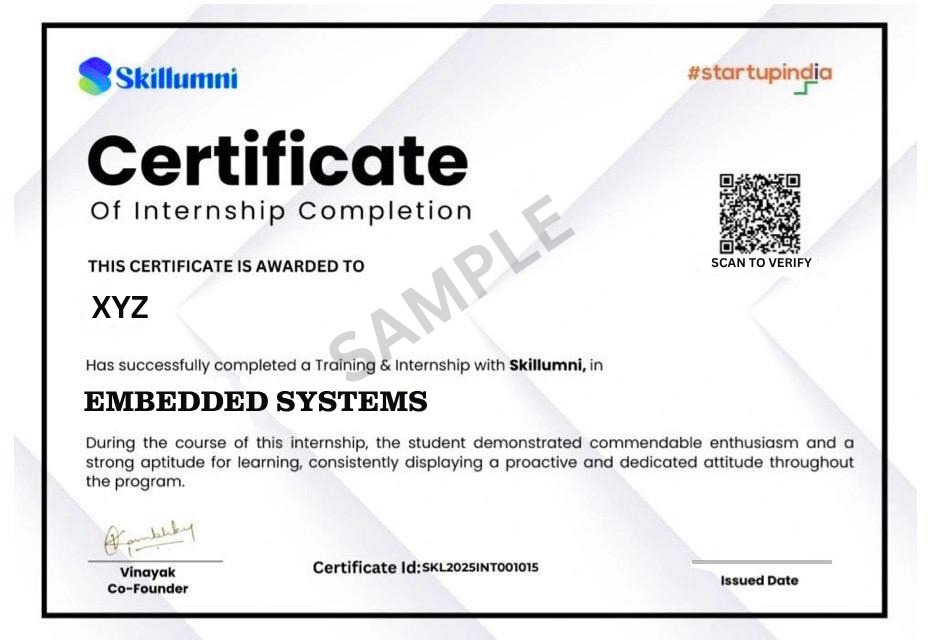
Your Dual Certificates
Two industry-recognized credentials awarded on successful completion
Why Choose This Course
Everything you need to go from curious learner to confident embedded engineer
Industry-Aligned Curriculum
A structured path from fundamentals to Arduino interfacing and motor control.
Hands-On Projects
Apply skills through LED, LCD, and motor interfacing projects in Proteus and TinkerCAD.
Dual Certification
Course Completion + Internship Certificate — two industry-recognized credentials in one program.
Performance-Based LOR
A star-rated, personalized Letter of Recommendation based on what you actually built and achieved.
1:1 Mentor Support
Direct access to mentors for doubt clearing, project reviews, and career guidance whenever you need it.
Placement Referrals
Direct referrals to our hiring partner network across embedded, IoT, and hardware engineering roles.
Requirements
- No prior embedded systems experience required — beginners welcome
- Interest in electronics, programming, IoT, or hardware design
- A computer with internet connection
- Arduino IDE and simulation tools recommended
Material Includes
- 35+ hours of recorded video lectures
- Lifetime LMS access — revisit anytime
- Section quizzes, assessments & assignments
- Industry-based hands-on projects
- Course Completion Certificate
- Internship Experience Certificate
Simple, Transparent Pricing
Pick the learning style that suits you best — both include dual certification and placement support