
What You'll Learn
Six core ML domains — from data pipelines to production-grade intelligent systems
ML Fundamentals & Types
Supervised, unsupervised, and reinforcement learning — understand how machines learn patterns and make predictions from data.
FoundationData Preprocessing & Feature Engineering
Cleaning, encoding, scaling, outlier treatment, PCA, and t-SNE — turning raw data into fuel for high-accuracy models.
Core SkillAlgorithms & Ensemble Methods
Regression, Decision Trees, Random Forest, SVM, Gradient Boosting, XGBoost — applied to real classification and prediction tasks.
In-DemandClustering & Anomaly Detection
K-Means, hierarchical clustering, Isolation Forest, Autoencoders — find hidden patterns and detect fraud, defects, and outliers.
AdvancedDeep Learning & Time Series
Neural networks, activation functions, ARIMA, SARIMA — build models that learn from sequences and temporal patterns.
Cutting EdgeMLOps & Deployment
Flask, FastAPI, MLflow, CI/CD pipelines — take trained models from notebooks into live, monitored production environments.
Production ReadyBuilt to Make You an ML Engineer
A program that goes from data to deployment — covering 14 modules, 8+ live projects, and real MLOps pipelines used in industry.
This course takes you through the complete machine learning lifecycle. You'll start with what ML actually is, explore the three types of learning, then build hands-on pipelines using Python, Jupyter, and Scikit-learn. Data preprocessing, feature engineering, and dimensionality reduction are covered in depth — because clean data is what separates good models from great ones.
From linear regression to ensemble methods, clustering to anomaly detection with autoencoders, time series forecasting with ARIMA/SARIMA, and deep learning basics — every concept is backed by a real project. The final stage covers MLOps: deploying models with Flask, FastAPI, and Django, managing experiments with MLflow, and automating pipelines with CI/CD. You'll graduate with a portfolio that proves you can ship ML, not just train it.
Course Benefits
Course Curriculum
Four stages, fourteen modules, one clear pipeline from raw data to production ML — click any module to expand
- What is ML — machines learning from data
- Supervised, Unsupervised & Reinforcement
- Real-world applications & industry impact
- Key terminology and concepts
- End-to-end ML pipeline overview
- Python, Jupyter, Google Colab setup
- Scikit-learn, Pandas, NumPy
- Build, train & evaluate first models
- Handling missing & incomplete data
- Categorical encoding techniques
- Data splitting — train/test/validation
- Building clean, reliable datasets
- Feature scaling — normalize & standardize
- Outlier detection & treatment
- Feature selection methods
- PCA & t-SNE dimensionality reduction
- Simple & Multiple Linear Regression
- Polynomial Regression
- Ridge, Lasso regularization
- Metrics — MSE, RMSE, R²
- Logistic Regression & KNN
- Decision Trees & Naive Bayes
- Random Forest & Gradient Boosting
- SVM — complex boundary classification
- K-Means clustering algorithm
- Hierarchical clustering
- DBSCAN for density-based grouping
- Finding hidden patterns in unlabeled data
- Isolation Forest & One-Class SVM
- Autoencoders for neural anomaly detection
- Fraud & defect detection use cases
- Evaluating anomaly detection models
- GridSearchCV & RandomizedSearchCV
- Bayesian Optimization
- Cross-validation strategies
- Model selection & comparison
- Time series components & patterns
- ARIMA modeling for forecasting
- SARIMA for seasonal data
- Evaluation & prediction intervals
- ANN architecture & neurons
- Layers, weights & backpropagation
- Activation functions & optimizers
- Intro to TensorFlow/PyTorch
- Deploy with Flask & FastAPI
- Django for ML-powered web apps
- REST API endpoints for ML models
- Docker basics for containerization
- MLflow for experiment tracking
- Model versioning & registry
- CI/CD for ML — automated pipelines
- Monitoring models in production
- AutoML tools — H2O, AutoSklearn
- End-to-end capstone ML project
- Portfolio presentation & review
- Career paths in ML engineering
Capstone Project · Dual Certification · Placement Ready
14 modules stacked into a production ML engineer — backed by 8+ live projects, MLOps skills, and a performance-based LOR.
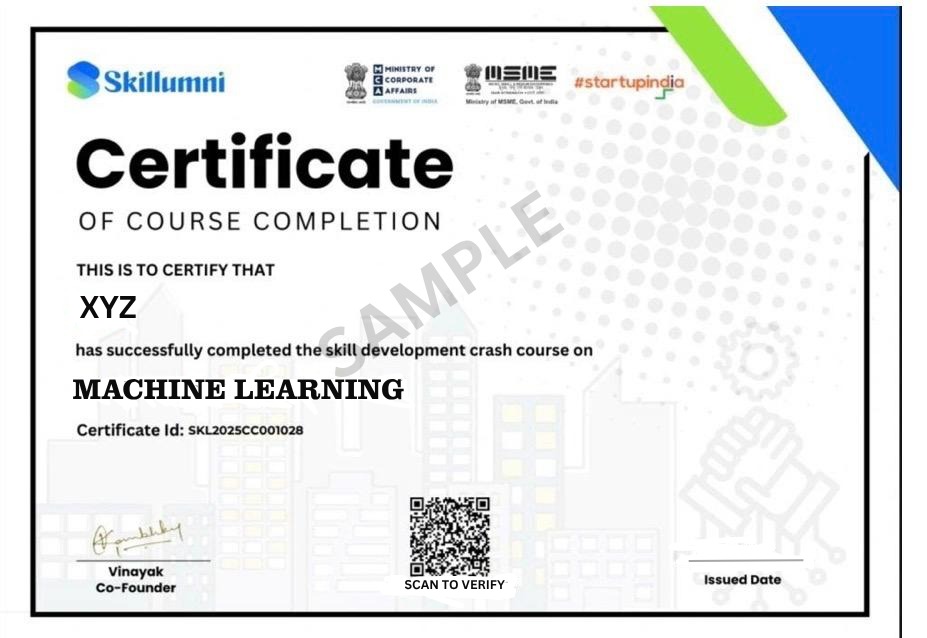
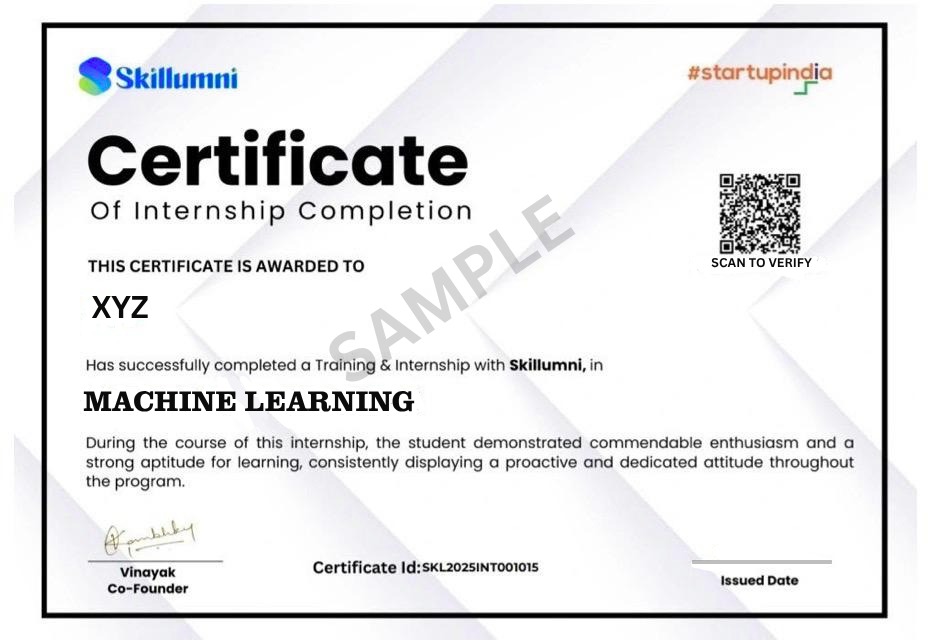
Your Dual Certificates
Two industry-recognized credentials awarded on successful completion
Why Choose This Course
Everything you need to go from data curious to production ML engineer
MNC-Certified Trainers
Learn from professionals who've built and shipped ML systems at scale in top tech companies — not just academics.
8+ Real ML Projects
Build a fraud detector, price predictor, time series forecaster, and more — all mentor-reviewed and portfolio-ready.
Dual Certification
Course Completion + Internship Certificate — two industry-recognized credentials that make your resume stand out.
Performance-Based LOR
A star-rated, personalized Letter of Recommendation based on what you actually built — not just attendance.
MLOps & Deployment
Most ML courses stop at model training. We take you all the way to Flask, FastAPI, MLflow, and CI/CD pipelines.
Placement Referrals
Direct referrals to our hiring partner network — Amazon, Google, Infosys, TCS, and 50+ companies hiring ML engineers.
Requirements
- Basic Python programming knowledge (we fill any gaps)
- Foundational understanding of maths & statistics
- A computer with internet connection
- Determination to learn and build ML applications
Material Includes
- 35+ hours of recorded video lectures by MNC-certified trainer
- Lifetime LMS access — revisit anytime
- Section quizzes, assessments & coding exercises
- 8+ industry-based hands-on ML projects
- Course Completion Certificate
- Internship Experience Certificate
Simple, Transparent Pricing
Pick the learning style that suits you best — both include dual certification and placement support