
What You'll Learn
Six core domains of genetic engineering — from the central dogma to CRISPR and real-world biotech applications
Molecular Biology Fundamentals
Genes, DNA, RNA, proteins, and the central dogma — the essential foundation every genetic engineer needs before touching a pipette.
FoundationLab Techniques & DNA Tools
PCR and its variations, gel electrophoresis, blotting techniques, DNA isolation, purification, and spectrophotometric analysis.
Core SkillCloning & Vectors
Restriction enzymes, ligases, gene amplification, plasmids, cosmids, viral vectors, and expression systems for gene delivery.
In-DemandCRISPR-Cas9 & Gene Editing
CRISPR guide RNA design, RNAi gene silencing, site-directed mutagenesis, and knock-in/knock-out strategies.
Cutting EdgeApplications: GMOs, Therapy & Biotech
Therapeutic proteins (insulin, vaccines), gene therapy, personalized medicine, biosensors, molecular diagnostics, and GMO development.
Applied ScienceBioinformatics & Ethics
NCBI, GenBank, sequence alignment, primer design, CRISPR off-target analysis, biosafety regulations, and IP in biotechnology.
AdvancedBuilt for the Next Generation of Life Scientists
A program that connects theory to application — covering 9 modules across molecular biology, gene editing, protein science, and biotech industry practice.
This course follows Skillumni's industry-aligned genetic engineering curriculum. You begin with the history and scope of the field, then build a solid foundation in molecular biology — genes, DNA, RNA, the central dogma, and how they connect to real biotechnology outcomes. Core lab techniques follow: DNA isolation, PCR, gel electrophoresis, and spectrophotometric analysis.
You'll then work through restriction enzymes and cloning, vectors and gene delivery, and master modern gene editing with CRISPR-Cas9, RNAi, and site-directed mutagenesis. The advanced modules cover protein expression and purification, applications in GMOs, gene therapy, and biosensors, and the full bioinformatics toolkit — NCBI, GenBank, primer design, and CRISPR off-target analysis. The course closes with ethical, legal, and regulatory frameworks every working biotechnologist needs to know.
Course Benefits
Course Curriculum
Three stages, nine modules, one complete pathway from molecular biology to biotech industry practice — click any module to expand
- History & evolution of the field
- Scope — healthcare, agriculture, industry
- Genes, DNA, RNA, proteins explained
- Central dogma of molecular biology
- DNA isolation & purification
- PCR — types & variations
- Gel electrophoresis & blotting
- Spectrophotometric analysis
- Restriction enzymes — types & role
- DNA ligases & joining techniques
- Gene amplification & cloning
- Selection markers & screening
- Plasmids, cosmids & viral vectors
- Gene transfer — prokaryotes & eukaryotes
- Expression systems for gene delivery
- Cloning vectors & reporter genes
- CRISPR-Cas9 — working, design & guide RNA
- RNA interference & gene silencing
- Site-directed mutagenesis
- Gene knock-in & knock-out strategies
- Recombinant protein production
- Purification using tags & chromatography
- Protein folding & solubility
- Structure-function relationships
- GMO development in agriculture
- Therapeutic proteins — insulin, vaccines
- Gene therapy & personalized medicine
- Biosensors & molecular diagnostics
- NCBI, GenBank & EMBL databases
- Sequence alignment & phylogenetics
- Primer design & codon optimization
- CRISPR off-target analysis & annotation
- Biosafety regulations & risk assessment
- Ethical considerations in gene modification
- Regulatory frameworks for GMO release
- IP & patent issues in biotechnology
Capstone Project · Dual Certification · Placement Ready
9 modules stacked into a job-ready life scientist — equipped with lab skills, gene editing expertise, bioinformatics tools, and a performance-based LOR.
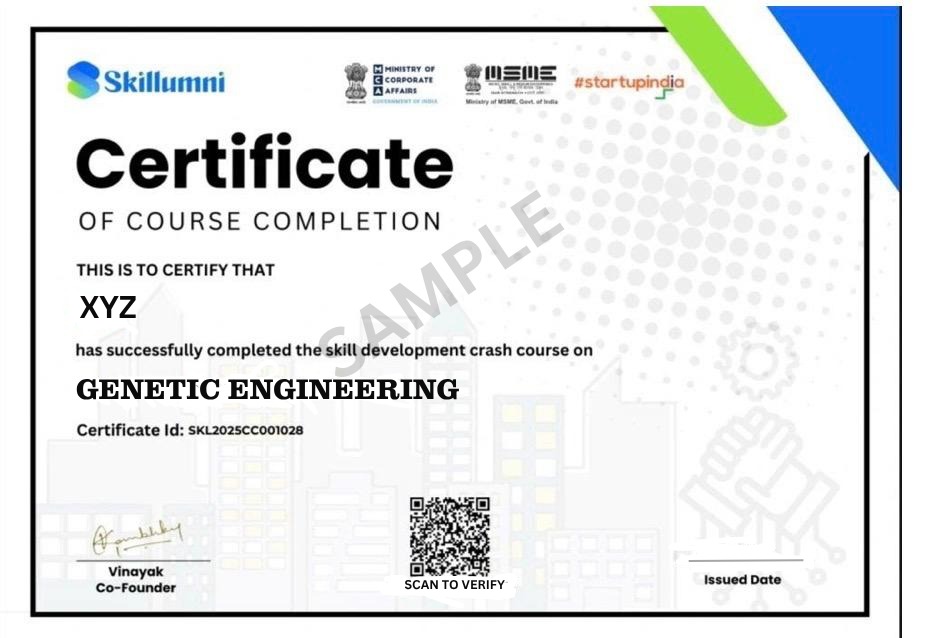
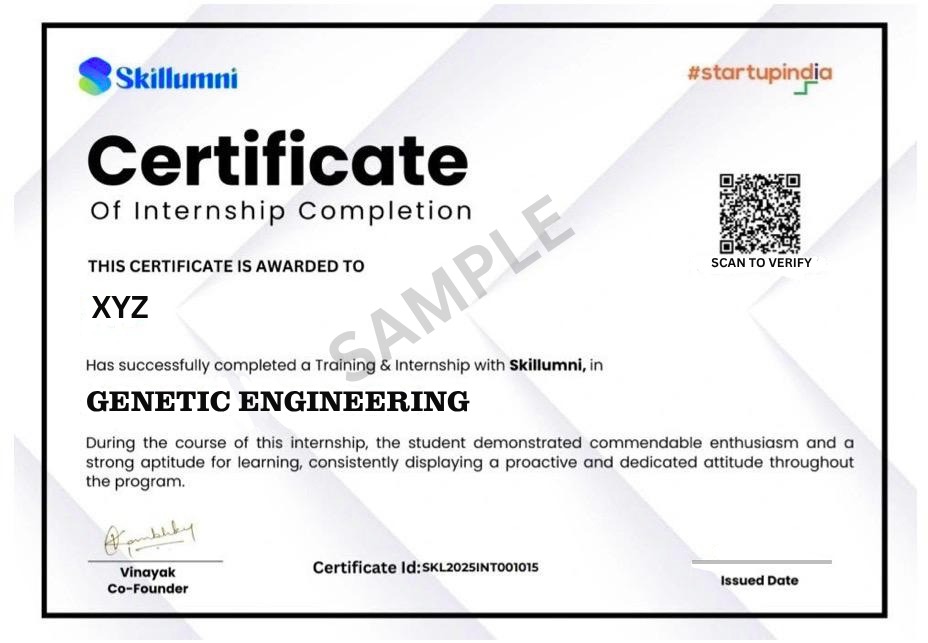
Your Dual Certificates
Two industry-recognized credentials awarded on successful completion
Why Choose This Course
Everything you need to enter the world of genetic engineering and life sciences professionally
Industry-Aligned Curriculum
Built on Skillumni's structured genetic engineering curriculum — from molecular biology basics to CRISPR, bioinformatics, and regulatory science.
In-Silico & Lab Projects
Apply primer design, sequence analysis, CRISPR guide RNA design, and gene editing workflows in guided, project-based modules.
Dual Certification
Course Completion + Internship Certificate — credentials recognized in biotech, pharma, agriculture, and research organizations.
Performance-Based LOR
A star-rated, personalized Letter of Recommendation based on your actual project work and performance — not attendance alone.
Expert Mentor Support
Direct access to molecular biology and biotech professionals for doubt clearing, project guidance, and career advice.
Career & Placement Support
Placement assistance and referrals to life science companies, biotech startups, pharma firms, and research labs in our network.
Requirements
- Basic biology or life sciences background (recommended, not mandatory)
- Interest in molecular biology, biotechnology, or healthcare
- Computer with internet connection
- Willingness to learn both lab concepts and computational tools
Material Includes
- 35+ hours of video lectures by life science experts
- Lifetime LMS access — revisit anytime
- Section quizzes, assessments & guided exercises
- In-silico projects — primer design, CRISPR analysis, sequence work
- Course Completion Certificate
- Internship Experience Certificate
Simple, Transparent Pricing
Pick the learning style that suits you best — both include dual certification and placement support