
What You'll Learn
Six core domains of nanotechnology — from nanomaterials and synthesis to real-world applications across electronics, medicine, energy, and environment
Nanomaterials & Fundamentals
Carbon nanotubes, graphene, metal nanoparticles, quantum dots, and nanocomposites — understanding nanoscale properties and why they matter.
FoundationSynthesis Techniques
Top-down and bottom-up approaches, Chemical Vapor Deposition (CVD), sol-gel method, and ball milling for creating nanomaterials.
Core SkillCharacterization Tools
SEM, TEM, AFM, XRD, and UV-Visible spectroscopy — instruments used to observe, measure, and validate nanoscale structures.
In-DemandElectronics, Medicine & Energy
Nano-transistors, flexible electronics, drug delivery systems, cancer therapy, nano solar cells, Li-ion batteries, and supercapacitors.
Applied ScienceNano Fabrication & Smart Materials
Clean room standards, lithography, thin film deposition, etching, nano robots, self-healing materials, and shape memory alloys.
AdvancedComputational Nanotechnology
Nano simulation tools, molecular modeling basics, Density Functional Theory (DFT), and MATLAB/Python for nanotechnology research.
Cutting EdgeBuilt for Engineers and Scientists of the Nano Age
A program that spans 12 modules across materials, fabrication, applications, and computation — covering everything from clean room practice to molecular simulation.
This course follows Skillumni's industry-aligned Nano Science & Nanotechnology curriculum. You begin with the definition, scope, and history of nanotechnology, then build understanding of nanoscale fundamentals and why nano-sized materials behave so differently from their bulk counterparts.
You then progress through types of nanomaterials (CNTs, graphene, quantum dots), synthesis routes (CVD, sol-gel, ball milling), and characterization techniques (SEM, TEM, AFM, XRD). The applied modules cover four major sectors — electronics, medicine, energy, and environmental engineering — before advancing to nano fabrication (lithography, etching, clean rooms), smart materials, and nano robotics. The course culminates in computational nanotechnology using molecular modeling and MATLAB/Python, and a capstone project with industry exposure, research review, and career guidance.
Course Benefits
Course Curriculum
Three stages, twelve modules, one complete pathway from nanoscale fundamentals to industry-ready research skills — click any module to expand
- Definition & scope of nanotechnology
- History & milestones of the field
- Nanoscale fundamentals & quantum effects
- Importance in modern engineering
- Carbon Nanotubes (CNT)
- Graphene & its properties
- Metal nanoparticles
- Quantum dots & nanocomposites
- Top-down vs bottom-up approaches
- Chemical Vapor Deposition (CVD)
- Sol-gel method
- Ball milling & other techniques
- SEM — surface imaging
- TEM — atomic-level imaging
- AFM — surface force mapping
- XRD & UV-Visible Spectroscopy
- Nano-transistors & logic devices
- Nano sensors for detection
- Flexible electronics
- Semiconductor nanotechnology
- Nano drug delivery systems
- Cancer therapy using nanoparticles
- Tissue engineering scaffolds
- Biosensors for diagnostics
- Nano solar cells — enhanced efficiency
- Lithium-ion battery improvements
- Hydrogen storage materials
- Supercapacitors & energy storage
- Water purification using nanofilters
- Air pollution control
- Waste treatment methods
- Environmental remediation
- Lithography techniques
- Thin film deposition
- Etching processes
- Clean room standards & protocols
- Nano robots — design & applications
- Self-healing materials
- Shape memory alloys
- Intelligent & stimuli-responsive materials
- Nano simulation tools overview
- Molecular modeling basics
- Density Functional Theory (DFT) intro
- MATLAB/Python in nanotech research
- Capstone project development
- Case study discussion
- Research paper review & analysis
- Presentation, viva & career paths
Capstone Project · Dual Certification · Placement Ready
12 modules stacked into a job-ready nano scientist — equipped with synthesis skills, characterization expertise, simulation tools, and a performance-based LOR.
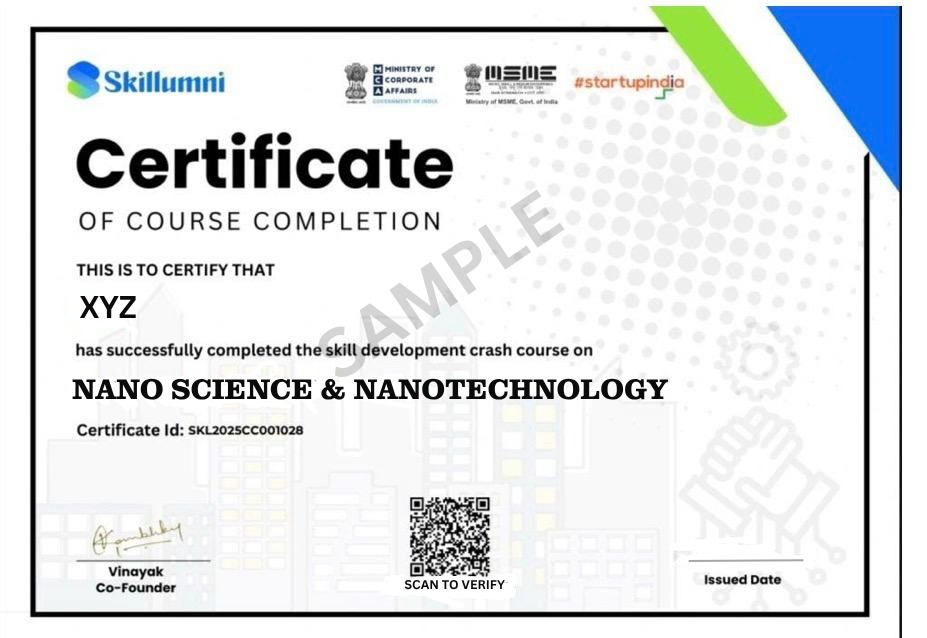
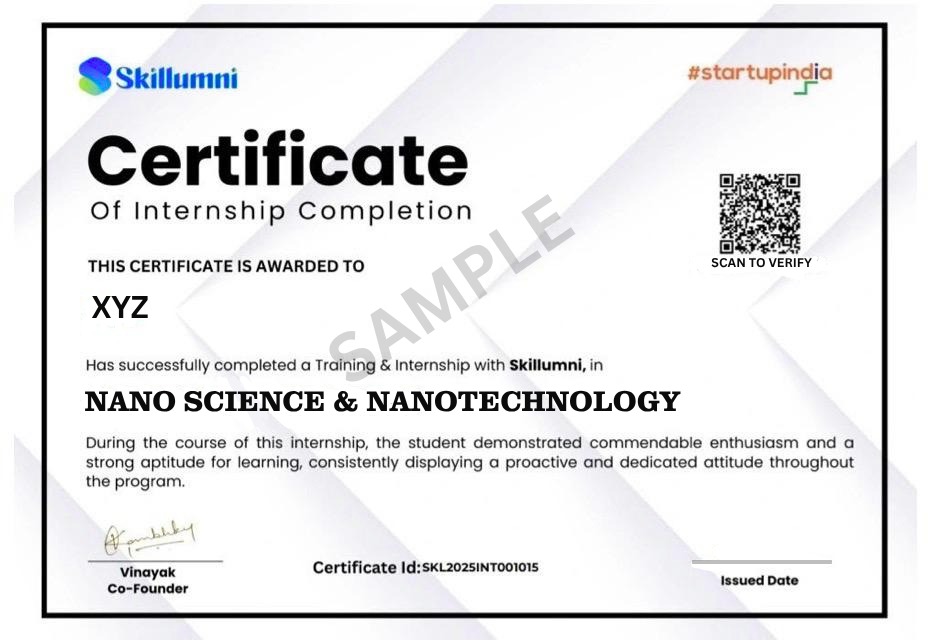
Your Dual Certificates
Two industry-recognized credentials awarded on successful completion
Why Choose This Course
Everything you need to enter the world of nanotechnology and materials science professionally
Industry-Aligned Curriculum
Built on Skillumni's structured nano science curriculum — from CNTs and synthesis to clean room fabrication, simulation, and career readiness.
Capstone Projects & Case Studies
Real project development, research paper reviews, industry case studies, and viva — portfolio-ready outcomes for R&D and engineering roles.
Dual Certification
Course Completion + Internship Certificate — credentials recognized in R&D labs, materials engineering, pharma, and electronics companies.
Performance-Based LOR
A star-rated, personalized Letter of Recommendation based on your project work and performance — valued by hiring managers in science and engineering.
Expert Mentor Support
Direct access to nanoscience and materials engineering professionals for doubt clearing, project guidance, and career advice throughout.
Career & Placement Support
Placement assistance and referrals to our network of R&D labs, biotech firms, electronics companies, and materials science organizations.
Requirements
- Basic science or engineering background (physics, chemistry, or biology)
- Interest in materials science, medicine, electronics, or energy
- Computer with internet connection
- Willingness to learn characterization and simulation tools
Material Includes
- 35+ hours of video lectures by nanoscience experts
- Lifetime LMS access — revisit anytime
- Section quizzes, assessments & exercises
- Capstone project, case studies & research reviews
- Course Completion Certificate
- Internship Experience Certificate
Simple, Transparent Pricing
Pick the learning style that suits you best — both include dual certification and placement support